
Inkblot Test
Twelve original ink cards. What do you see?
10 min · Free · No account
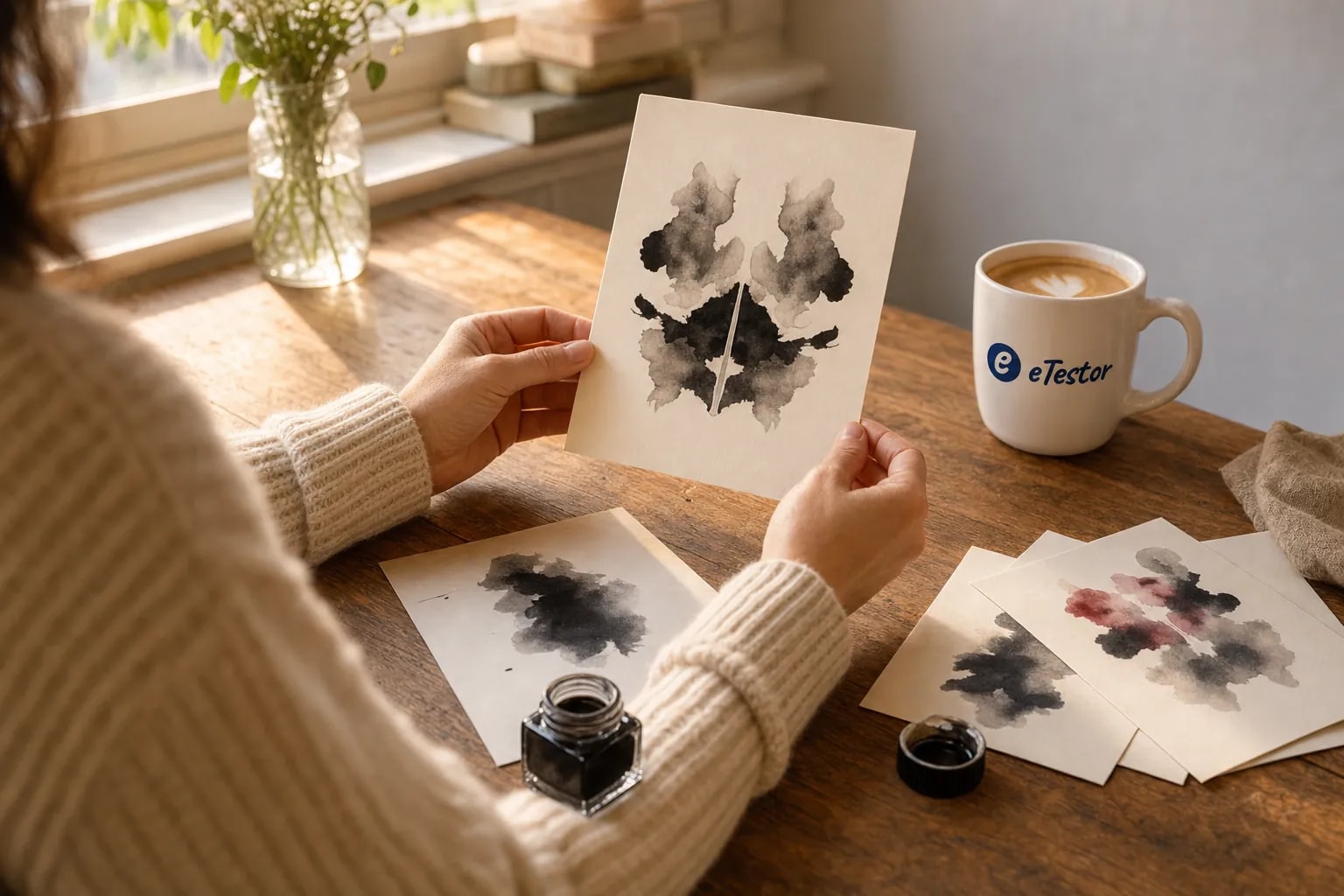
What is the inkblot psychology test?
The best-known inkblot test is the one the Swiss psychiatrist Hermann Rorschach published in 1921: ten symmetrical ink cards, shown one at a time, and the question of what each one might be. A psychologist then scores where on the card you looked, what made it look that way, such as its shape, color or a sense of movement, and what you saw. Whether those scores reveal personality is still argued over. This test is not the Rorschach: it uses twelve cards of our own and is made for fun.
About this test
Twelve ink cards, drawn for eTestor, and 48 questions about what you see in them: where your eye goes first, whether the shape is moving, whether you see people, what the color and shading do, and how unusual your answer is. Your answers point to one of six ways of reading an inkblot, from the Big-Picture Seer to the Inventor. This is not the Rorschach test and not a clinical assessment. Psychologists still argue about what inkblot answers can reveal, and our cards and scoring have never been studied. Take it as a playful look at how you see.
What you'll discover
Whole picture
How often you took in the whole blot and made one thing out of it.
Small details
How often your eye went to small parts, edges, gaps and drops.
Movement
How often the shapes you saw were doing something: flying, pulling, drifting.
People
How often you saw faces, figures and people in the ink.
Color and mood
How much the color, shading and feel of a card changed what you saw.
Originality
How often you skipped the obvious reading for one of your own.
Understanding the Inkblot Test
This inkblot test shows you twelve ink cards, one at a time, and asks four questions about each, 48 in all: where your eye went first, whether the shape is moving, whether you see people in it, what the color and shading do, and whether you went for the obvious reading. It takes about 10 minutes. Your inkblot style is free when you finish: the Big-Picture Seer, the Detail Hunter, the Storyteller, the People Reader, the Mood Reader or the Inventor. The full report shows all six scores, so you can see which ones ran close.
We made the cards ourselves, by computer, to look like ink pressed between folded card: each one is mirrored left to right, most are black with a grey wash, two have red in them and one is in several colors. Psychologists still use Rorschach's original ten in real assessments, so we kept them out. Our six styles borrow the broad questions inkblot answers have long been scored on: did you use the whole blot or a part of it, did you see movement or people, did the color change what you saw, how common was your answer. Linking those habits to a personality is our own playful reading, nothing more.
We should be plain about the research. Psychologists have argued about the Rorschach for decades. A 2000 review by Scott Lilienfeld, James Wood and Howard Garb found support for a small number of Rorschach indexes, but concluded that the substantial majority were not supported by the evidence (Psychological Science in the Public Interest, doi:10.1111/1529-1006.002). A 2013 set of meta-analyses by Joni Mihura and colleagues found the best support for the scores tied to how people perceive and think, and little or none for several others (Psychological Bulletin, doi:10.1037/a0029406). Our cards and our scoring have never been studied at all. Treat your result as a conversation about how you look at things, not a finding about who you are.
Where the Inkblot Test comes from
The Swiss psychiatrist Hermann Rorschach published his ten inkblot cards in 1921, in the book Psychodiagnostik. Psychologists later built several scoring systems on them, and the cards are still used in clinical and forensic assessment. This test does not use those cards: its twelve cards were drawn by eTestor, and its six reading styles are our own.
How the Inkblot Test is scored
Six reading styles, each scored from 8 to 40: five multiple-choice questions about the cards (1, 3 or 5 points) and three statements, one of them reverse-worded. The highest style is your result. The styles borrow broad categories clinical inkblot answers are coded by, such as whole versus detail, movement, human figures, color and how common an answer is, but the scoring is ours and has never been validated. Research on the Rorschach itself is mixed: in a 2013 review of the 65 main variables of its most widely used scoring system, those with the strongest support mostly measured perception and thinking, and several had little or no support.
Questions people ask
Is the inkblot test free?
Yes. The test and your inkblot style are free, with no account needed: just your email at the end. Every score, the written analysis and the certificate are in the full report: $1.99$2.41 in the first 30 minutes after you finish, $3.99$4.83 after that, or included in eTestor Unlimited.
Are these the real Rorschach inkblots?
No. All twelve cards were made for eTestor, and none is a copy of a Rorschach card. The original ten from 1921 are still used in real psychological assessments, where seeing them in advance could change someone's answers, so we left them out. Ours follow the same idea: a symmetrical shape that is open to many readings.
What do inkblot answers mean? Are there right answers?
There are no right or wrong answers. In a clinical assessment, a trained psychologist scores many features of what you say, and reads them alongside interviews and other tests. Here your answers simply count toward six reading styles, such as seeing the whole shape or the small details. Seeing a bat, a mask or something nobody else would name doesn't mean anything is wrong with you.
Is the inkblot test accurate?
The clinical Rorschach has mixed evidence. Reviews by Lilienfeld, Wood and Garb (2000) and by Mihura and colleagues (2013) found that some of its scores hold up, mostly those about perception and thinking, while many others have weak or no support. This test makes no clinical claim and has not been validated: it's accurate only about which answers you picked.
Why do people see different things in the same inkblot?
The blots are ambiguous on purpose, so your mind fills the gaps with whatever fits best. A 2017 study by Richard Taylor and colleagues measured the edges of the Rorschach blots and suggested that their fractal, crinkly edges are what make people see images in them (PLOS ONE, doi:10.1371/journal.pone.0171289). What you then name depends on what you notice first, what's been on your mind and what you've seen lately.
More Fun & Viral tests
Soldier, Poet or King Quiz
Soldier, poet or king? 48 questions about everyday moments show which of the three you are.
8 min
Aesthetic Quiz
Cottagecore or dark academia? 50 statements about your taste match you to one of ten aesthetics.
8 min
Which Fictional Character Are You?
Answer 48 scenarios and discover which iconic character matches your personality.
8 min
Sarcasm & Wit Test
Fluency, detection, dry humor, and sincerity tolerance — 40 questions rate your wit across four dimensions.
8 min
Which Zodiac Sign Are You Actually?
48 questions match your vibe to one of the 12 zodiac signs. A playful quiz, just for fun.
8 min
Chronotype Test: Lion, Bear, Wolf, or Dolphin?
Lion, Bear, Wolf, or Dolphin — 44 questions reveal your body's built-in schedule.
9 min