
Memory Test
Words, numbers, names, patterns and details, from memory
15 min · Free · No account
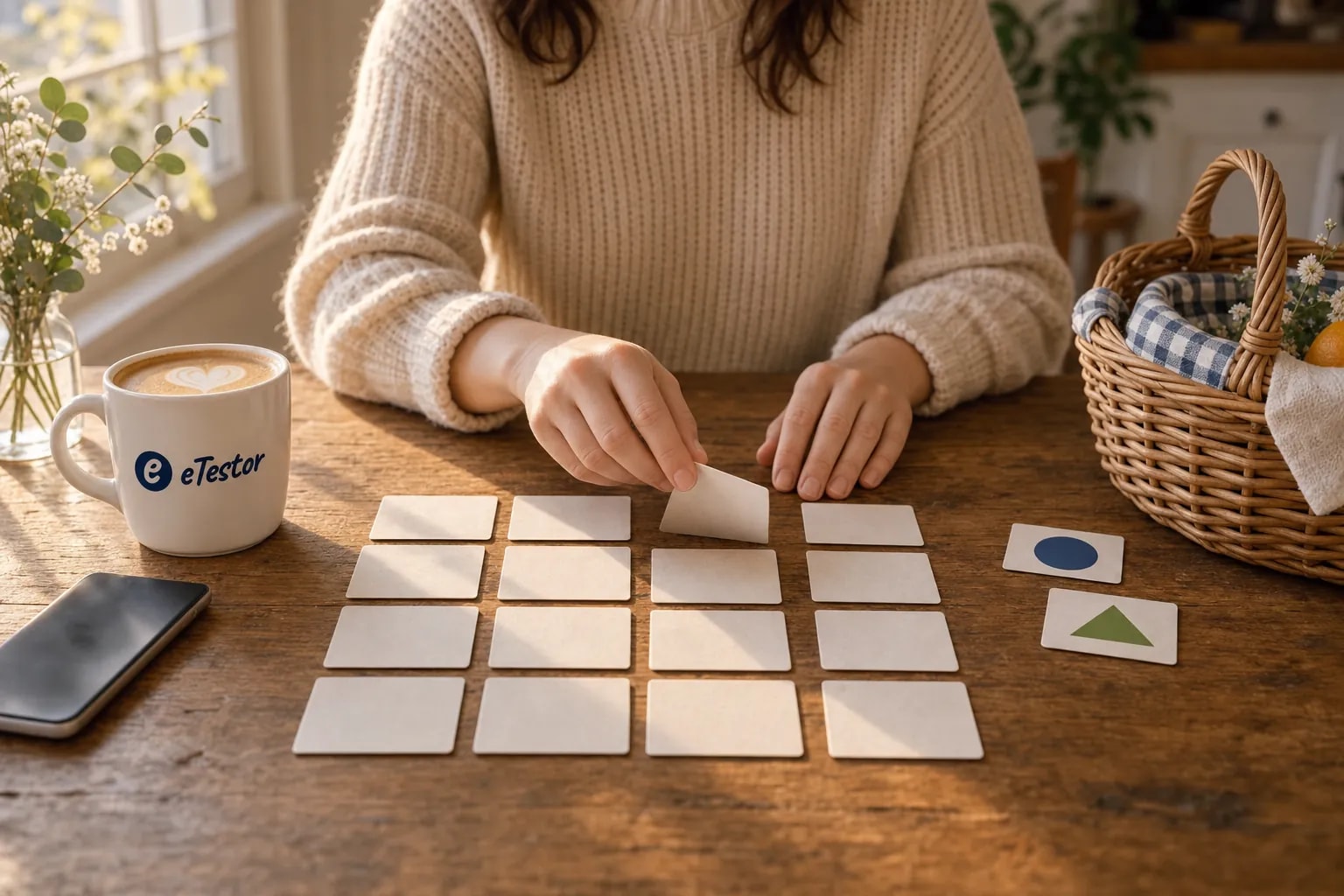
Do I have a photographic memory?
Almost certainly not, and that is true of nearly every adult. The closest real thing is eidetic imagery, an image that seems to stay in view after the picture is gone. Ralph Haber, reviewing his ten-year study of school children, found it in a small percentage of children aged 6 to 12 and called it "virtually nonexistent in adults" (Behavioral and Brain Sciences, 1979, doi:10.1017/S0140525X00064542). People who seem to remember everything usually have a strong ordinary memory and good habits for using it. This test measures the part you can check online: how much you hold for a few seconds.
About this test
Five areas, ten questions each: Words (lists of 5 to 10 words), Numbers (strings of 5 to 9 digits), Names (3 to 6 people, each with a detail), Patterns (3×3 and 4×4 grids of filled and empty squares) and Details (short notices and stories with times, prices and places). Every question shows the material first, then hides it before you answer. It is a rough estimate of short-term memory, not a medical test.
What you'll discover
Words
Remembering a list of words: which ones were on it, and in what order.
Numbers
Holding a string of digits in mind, the skill behind keeping a phone number or a code in your head.
Names
Matching people to a detail about them, such as a job, a city or a room number.
Patterns
Remembering where things were: which squares in a grid were filled.
Details
Picking up the facts in a short notice or story: times, prices, places and who did what.
Understanding the Memory Test
This memory test has 50 questions in five areas: words, numbers, names, patterns and details. Each one first shows you something to study, such as a word list, a string of digits, names, a grid or a short notice. It disappears after a few seconds, or when you tap I'm ready, and then you answer one question about it. Each area starts easy and gets harder, and you can't go back. It takes about 15 minutes. Your total score is free when you finish, and the full report scores each area.
How much should you be able to hold? George Miller's 1956 paper put the span of immediate memory at about seven items, plus or minus two (Psychological Review, doi:10.1037/h0043158). Nelson Cowan later argued that when people can't group or rehearse what they see, the real limit is closer to four chunks (Behavioral and Brain Sciences, 2001, doi:10.1017/S0140525X01003922). The gap between those numbers is grouping: 4 7 2 9 is four items, but 47 29 is two. One word list is also built to fool you: its words all point to a word that was never on it, a trap borrowed from false-memory research (Roediger and McDermott, 1995, doi:10.1037/0278-7393.21.4.803).
Be clear about what this is. It is a rough estimate of your short-term memory on one day, and sleep, stress and a buzzing phone can all pull it down. It has no norms yet, so it can't tell you how you compare with people your age. It is not a dementia test or a medical check of any kind. If you or someone close to you is worried about memory, for example forgetting recent conversations or getting lost on familiar routes, talk to a doctor, who can look at causes a quiz can't, such as sleep, medicines or mood.
Where the Memory Test comes from
Short-term memory capacity is one of the oldest questions in experimental psychology. George Miller's 1956 paper put the span of immediate memory at about seven items, plus or minus two, and Nelson Cowan's 2001 review argued that the core limit is closer to four chunks when people can't group or rehearse. This test is our own construction in that tradition, with recognition questions in place of spoken recall; it is not a published instrument.
How the Memory Test is scored
Five areas of ten questions, each scored as the number correct (0 to 10), plus a total out of 50. With four options per question, guessing alone averages 12.5 of 50. The test has no norms yet, so scores are not percentiles, and it is not a clinical or dementia screening tool. On photographic memory, Ralph Haber's 1979 review found eidetic imagery in a small percentage of children aged 6 to 12 and virtually none in adults.
Based on a published, peer-reviewed model
Questions people ask
Is the memory test free?
Yes. The test and your total score are free, with no account needed: just your email at the end. Every score, the written analysis and the certificate are in the full report: $1.99$2.41 in the first 30 minutes after you finish, $3.99$4.83 after that, or included in eTestor Unlimited.
How do I know if I have a photographic memory?
No online test can confirm one, because there's little evidence it exists in adults. A true photographic memory would mean reading details off an image you only glanced at, as if it were still in front of you. Haber's review of eidetic imagery found it in a small percentage of children and virtually none in adults. A high score here means a strong short-term memory, which is real and useful, and is not the same thing.
What is a good score on this memory test?
Each question has four options, so guessing alone gets about 12 of 50 right. Above 25 means most of the easier items stuck; 40 or more means you held most of the hard ones too. We don't have norms yet, so read these as rough guides, not percentiles.
Is this a short-term memory test or a working memory test?
Mostly short-term memory: you hold items for a few seconds and then pick them out. Some questions also ask you to work with what you hold, such as reading a digit string backwards or naming the word that came between two others, which is closer to working memory. A clinical digit span test asks you to say the digits back; here you choose the right string from four, which is easier.
Is this a dementia test?
No. It can't detect dementia or any other medical condition, and it was not built to. Memory screening is done by a doctor with tests designed and checked for that purpose. A low score here can come from a tired or distracted sitting. If memory problems are affecting daily life, yours or someone else's, a doctor is the right person to see.
More Cognitive & Intelligence tests
Common Sense Test
50 everyday situations at home, with money, safety, people and how things work. One best answer each.
10 min
IQ Test
Pattern matrices, sequences, spatial rotation, logic and a timed speed round — scored to a real IQ with percentile.
25 min
Left Brain / Right Brain Test
List-maker or leaper? 44 questions score your analytical and creative sides — honestly, metaphor and all.
9 min
Decision-Making Style Test
Analyst, gut reader, counsel gatherer, deliberator, or leaper? 45 scenarios reveal how you really decide.
9 min
Curiosity Test
Wanderer or digger? 40 statements measure the two appetites of a curious mind.
8 min