
Aesthetic Types: 10 Aesthetics and How to Find Yours
Cottagecore, dark academia, old money, Y2K and six more: where each one came from, its pieces, colors, rooms and music, and how to mix two
· 11 min read
Take the Aesthetic Quiz: free, and your main result is free when you finish.
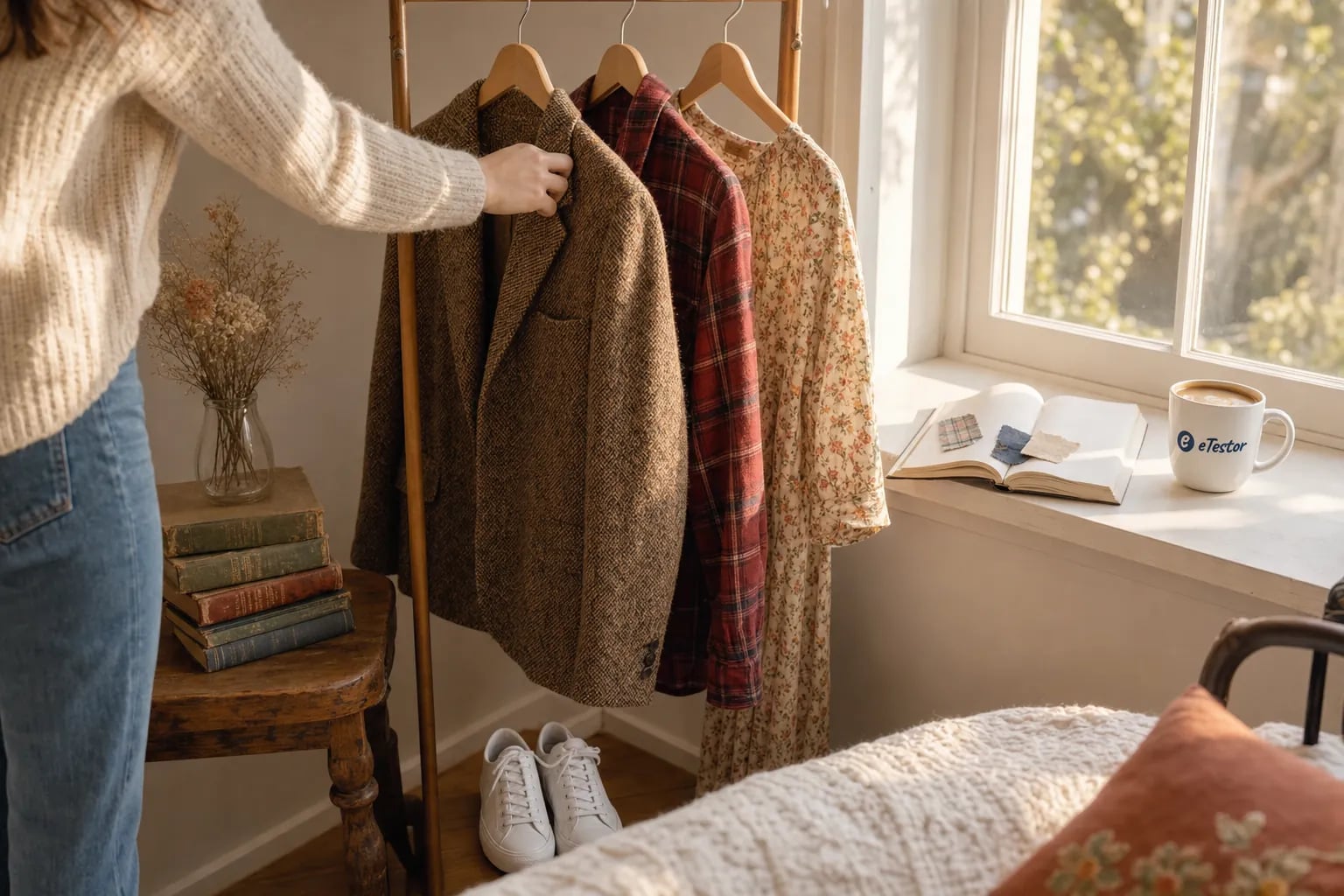
What are the different types of aesthetics?
An aesthetic, in the way people use the word online, is a whole look and mood with a name: the clothes, the colors, the kind of room, the music and even the kind of weekend that go together. The best known today are cottagecore, dark academia, old money, minimalist, streetwear, boho, grunge, Y2K, coastal and coquette, and you'll probably recognize yourself in one or two.
Some are new names for old styles. Boho goes back to the hippie looks of the 1960s and 70s, grunge to the music scene of the Pacific Northwest around 1990, minimalism to American art of the 1960s. Others grew up on social media in the last ten years.
There's no official list. The ten here are among the most searched in the US, and the ones our aesthetic quiz scores. For each we give where it came from, from news reports and research we checked, then its pieces, colors, rooms and music.
What aesthetic am I? How our aesthetic quiz works
Our aesthetic quiz has 50 statements about everyday taste, five for each of the ten aesthetics: the room you'd love to wake up in, what you wear on a lazy Sunday, the music on while you cook, the colors you keep buying. One of each five is reversed, so agreeing with everything doesn't push every score up. It takes about 8 minutes.
All ten are scored, and your highest is your aesthetic, free when you finish. The full profile shows how close the other nine came, which matters: if a second aesthetic comes close behind, the pair describes you better than either alone.
We built the quiz ourselves, for fun. It's a style quiz, not a personality test, and no research stands behind the statements or the scoring.
The 10 main aesthetics: pieces, colors, rooms and music
Cottagecore
Where it came from: a romantic picture of country life that boomed in the 2020 lockdowns. NPR reported that the hashtag was first used on a blogging site in March 2014 and that its use there jumped 153% between March and April 2020. A museum of rural life pointed out the long history behind it: Marie Antoinette had a rustic hamlet built near Versailles in the 1780s so she could play at farm life. Pieces: cotton and linen dresses, small floral prints, puffed sleeves, cardigans, straw baskets. Colors: cream, sage, butter yellow, soft pink. Rooms: a wooden table, open shelves, dried flowers, jars of things you made. Music: folk and acoustic guitar. The point is doing more than buying: baking, mending, growing.
Dark Academia
Where it came from: versions of it spread on image sites in the mid-2010s and took off on short-video apps at the end of 2020, when students stuck at home missed their campuses (CNN, 2022). A historian who studied it describes it as recreating the mood of boarding schools and colleges from the late 1800s to the 1940s: neo-gothic buildings, tweed, wool, leather and Romantic longing (Adriaansen, International Public History, 2022, doi:10.1515/iph-2022-2047). Its favorite books are The Secret History and The Picture of Dorian Gray, and the film most often named with them is Dead Poets Society. Pieces: tweed blazers, sweater vests, turtlenecks, pleated skirts, worn loafers. Colors: brown, forest green, burgundy, black. Rooms: books stacked everywhere, a desk lamp, candles, rain on the window. Music: classical piano and string covers of rock songs.
Old Money
Where it came from: CNN described it in 2022 as a tongue-in-cheek, aspirational style blending vintage and preppy pieces to look like people born into wealth. Under another name, quiet luxury, it flourished on social media in 2023 (CNN, 2024), the year CNN wrote that a television drama's costumes had created an archetype of logo-less "stealth wealth". Pieces: navy blazers, cable knits, cashmere, crisp shirts, loafers, pearls, nothing with a visible logo. Colors: navy, cream, camel, white, bottle green. Rooms: antiques, wood, worn rugs, books that have been read, paintings in heavy frames. Music: jazz standards, classical, a crackling record.
Minimalist
Where it came from: the name belongs to an art movement. Tate dates minimalism to the late 1950s and 1960s in the United States, when artists made work out of simple geometric shapes; the painter Frank Stella summed it up as "What you see is what you see". As a way of living it means owning fewer things and choosing each one. Pieces: plain tees, good trousers, one coat, a small wardrobe where everything goes with everything. Colors: white, black, grey, beige. Rooms: clear surfaces, plain walls, storage that hides things, one plant. Music: ambient, instrumental, quiet electronic.
Streetwear
Where it came from: surf, skate and hip-hop in the 1980s. Time reported in 1991 on a former surfboard maker in California who started his business in 1982 by printing surfboard graphics on T-shirts and shorts, a label hip-hop musicians then adopted. In New York, a fashion museum curator told CBS in 2023 that a Harlem designer who remixed luxury logos into streetwear changed the course of fashion. Pieces: sneakers, hoodies, graphic tees, caps, loose jeans or cargos. Colors: black, white, grey and one loud color. Rooms: sneakers on display, posters, records, a skateboard by the door. Music: hip-hop, and the punk and rock skaters played.
Boho
Where it came from: short for bohemian, the old word for artists who lived outside convention. As a fashion label, CNN dates "boho chic" to the early 2000s, a nod to 1960s and 70s hippie clothes: suede fringe, crochet and paisley, made famous by festival outfits around 2004. It later drew criticism when festival-goers wore sacred Native American headdresses as costume, and some festivals banned their sale. Pieces: maxi dresses, fringe, crochet, loose layers, stacked jewelry. Colors: terracotta, mustard, olive, rust. Rooms: rattan, macramé, patterned rugs, more plants than shelves. Music: folk rock and 1970s singer-songwriters.
Grunge
Where it came from: the rock scene of Seattle and the Pacific Northwest in the late 1980s and early 1990s. Its best-known band wore distressed jeans, tattered sweaters and flannel shirts for most of its career (CNN, 2019). A French designer told a fashion magazine in 1993 that grunge was "nothing more than the way we dress when we have no money." The scene didn't take itself seriously: when a newspaper asked a Seattle record label for a dictionary of grunge slang, an employee made up words on the spot, such as "swingin' on the flippity-flop" for hanging out (NPR, 2009). Pieces: flannel, ripped jeans, band tees, worn boots, oversized cardigans. Colors: faded black, olive, oxblood, washed-out plaid. Rooms: posters, thrifted furniture, a record player. Music: loud 1990s guitars.
Y2K
Where it came from: the look of the late 1990s and early 2000s, back on a fashion cycle of about twenty years. The founder of the Consumer Aesthetics Research Institute, which documents design history, told CNN in 2022 that the era carried over ideas from 1960s space-age design and that "in the Y2K era everything was plastic, shiny". Most of the people reviving it weren't born when it first came round. Pieces: baby tees, low-rise jeans, parachute pants, tinted sunglasses, anything metallic. Colors: silver, chrome, baby blue, hot pink, see-through plastic. Rooms: inflatable or translucent furniture, glitter, a lava lamp. Music: turn-of-the-millennium pop and R&B.
Coastal
Where it came from: beach-house style got a new name in 2022, when a 26-year-old creator coined "coastal grandmother" for a beachy, romantic look (NPR, 2022). Its reference points: the film Something's Gotta Give, a good cookbook and a cashmere sweater tied over the shoulders. Pieces: linen shirts, striped tops, white jeans, canvas shoes, a straw hat. Colors: white, sand, navy, sea blue. Rooms: light and airy, slipcovered sofas, driftwood, woven baskets, a vase of hydrangeas. Music: soft rock, bossa nova, quiet jazz.
Coquette
Where it came from: coquette is an old French word for a flirt, and The Coquette was the title of an American novel in 1797. As an aesthetic it's recent. A fashion reporter told NPR in 2024 that recent trends had been "quite girlish", pointing to "the bows, the coquette core", and NBC News listed the "coquettish hyperfeminine" among the short-lived looks of that year. Pieces: bows and ribbons on everything, lace, pearls, ballet flats, slip dresses, frilly socks. Colors: blush pink, cream, pale blue, white. Rooms: something heart-shaped, a canopy or frills, a vanity, handwritten letters. Music: dreamy pop and old romantic ballads.
Where internet aesthetics come from
Most of these aesthetics started as collections of pictures: someone names a feeling, and others add images until the name means a whole way of dressing, decorating and spending a Saturday. The suffix "-core", as in cottagecore, became the usual way to name one, and it spawned smaller offshoots: NPR's 2020 report on cottagecore already listed "goblincore", "frogcore" and a darker "goth cottagecore".
Two forces push them into the mainstream. One is time at home: both cottagecore and dark academia surged during the 2020 lockdowns, when people who couldn't go anywhere built the life they wanted out of pictures, bread and books. The other is the fashion cycle. CNN's 2022 report on the Y2K revival called it the "unerring 20-year-trend cycle", which is why the early 2000s came back in the early 2020s.
They also burn out faster. A 2024 NBC News report found aesthetics becoming "more niche and short-lived", and shoppers who had never owned more clothes yet felt they had nothing to wear. We'd treat an aesthetic as a direction, not a shopping list.
How to mix two aesthetics
The simplest rule we know: pick one aesthetic as your base, the one that covers most of your clothes and your room, and borrow one or two pieces from a second. Half and half usually looks like a costume change.
Pairs that share something mix most easily. Dark academia and cottagecore share wool, old books and candlelight; mixed together they become dark cottagecore, which gets around 2,900 searches a month in the US on its own. Minimalist and old money share restraint and neutral colors; the result is the clean, quiet look with nothing showing its price. Grunge and Y2K share a love of thrift shops; a flannel shirt over a baby tee is pure late-1990s. Coastal and boho share linen and rattan. Coquette and dark academia share an old-fashioned romantic streak; a hair bow with a tweed blazer is one of the easiest mixes there is.
Pairs that clash can work on purpose: a hoodie under a navy blazer, lace with worn boots. Let one piece clearly break the rule, so it looks chosen.
Old money, quiet luxury and new money: what's the difference?
Old money is an aesthetic, quiet luxury is the shopping habit behind it, and new money is what both are defined against. Research on status signals explains the logic well.
In a 2010 study, Young Jee Han, Joseph Nunes and Xavier Drèze sorted luxury buyers by wealth and need for status (Journal of Marketing, doi:10.1509/jmkg.74.4.015). Wealthy buyers with little need for status paid a premium for "quiet" goods that only other insiders could recognize. Wealthy buyers with a strong need for status preferred loud logos, to separate themselves from people with less money. The same year, Jonah Berger and Morgan Ward found that people with more expertise in a field prefer subtle signals that only fellow insiders can read, even though outsiders then misjudge what they're wearing (Journal of Consumer Research, doi:10.1086/655445).
That's old money in two studies: the signal is aimed at people who already know. The irony is that a look meant for insiders became one of the most copied styles online, and copying it well mostly means buying fewer things and looking after them.
What your room and your playlist say about you
Your surroundings do say something about you. In a 2002 study, Samuel Gosling and colleagues had strangers look at people's bedrooms and offices, without meeting them, and rate their personality (Journal of Personality and Social Psychology, doi:10.1037/0022-3514.82.3.379). The strangers agreed with each other, their impressions were partly accurate, and they relied on real clues in the rooms.
Music tells a similar story. Across studies of more than 3,500 people, Jason Rentfrow and Gosling found that music tastes fall into four broad groups (reflective and complex, intense and rebellious, upbeat and conventional, energetic and rhythmic) and that these relate to personality, including openness to experience (Journal of Personality and Social Psychology, 2003, doi:10.1037/0022-3514.84.6.1236).
Taste in music, rooms and clothes travels with personality, if loosely. If you want the personality side measured properly, the Big Five personality test is the one with the research, and our Big Five guide explains it.
How to find your aesthetic without buying a new wardrobe
Start with what you already reach for. Take the five pieces of clothing you wear most and the corner of your home you like best, and match them to the lists above. You may well find one aesthetic in your clothes and another in your rooms.
Then look at what you save: the pictures you keep, the rooms you linger on in films. They show your taste with no budget attached. If most of them are wood and books, you're closer to dark academia than your closet says.
Only then fill gaps, slowly and secondhand where you can. For a starting point, take our aesthetic quiz and look at your top two. The color personality test and the nostalgia test are good companions.
It takes about 8 minutes.
What your aesthetic does and doesn't say about you
Your aesthetic says what you find beautiful and comfortable, and sometimes what kind of life you'd like to be living. That's worth knowing: it makes shopping easier, rooms calmer and gifts better. It says much less about who you are. A grunge fan can be the most organized person in the office, and someone in pearls and bows can be the toughest negotiator in the room.
Aesthetics also change. A style you loved at 16 may look like a costume at 30, and that's taste growing up. If our quiz puts you somewhere that doesn't feel right, look at your second and third aesthetic in the full profile, or trust your own eye over ours.
Questions people ask
What is the most popular aesthetic?
By US searches, cottagecore (about 60,500 a month) and dark academia (about 49,500), going by search volumes for October 2026.
How many aesthetics are there?
There's no official count. New ones are named every season, most of them small variations on a dozen or so big ones like the ten in this guide.
What is the coastal grandmother aesthetic?
The coastal aesthetic under the name it got in 2022: linen, stripes, a white sofa and a well-used beach-house kitchen. No grandchildren required.
What is dark cottagecore?
Cottagecore with the lights turned down: forests instead of meadows, darker florals, candles, foraging and a touch of fairy tale. It borrows heavily from dark academia.
What is the opposite of the old money aesthetic?
New money: visible logos, the latest releases and things chosen to be noticed. Research on luxury buyers finds this loud style appeals most to people with a strong need for status.
What's the difference between an aesthetic and a trend?
A trend is one item or look that comes and goes in a season. An aesthetic is a whole set of tastes, in clothes, rooms and music, that can last for years.
Sources
- Bowman, E. (2020, August 9). The escapist land of 'cottagecore,' from Marie Antoinette to Taylor Swift. NPR. www.npr.org/2020/08/09/900498227/the-escapist-land-of-cottagecore-from-marie-antoinette-to-taylor-swift
- Andrew, S. (2022, January 29). A guide to 'dark academia,' the TikTok-popular aesthetic with preppy style and an intellectual focus. CNN. www.cnn.com/style/article/dark-academia-tiktok-aesthetic-cec
- Adriaansen, R.-J. (2022). Dark Academia: Curating affective history in a COVID-era internet aesthetic. International Public History, 5(2), 105-114. doi.org/10.1515/iph-2022-2047
- Hills, M. C. (2022, August 31). Princess Diana's style is still shaping fashion 25 years after her death. CNN. www.cnn.com/style/article/princess-diana-25-years-death-fashion-legacy
- Palumbo, J. (2023, May 22). The mourning dress codes of 'Succession'. CNN. www.cnn.com/2023/05/22/style/succession-funeral-fashion-michelle-matland
- Yurkevich, V. (2024, February 5). Loud budgeting is in, quiet luxury is out. Meet the TikToker who started the financial trend. CNN. www.cnn.com/2024/02/05/economy/loud-budgeting-financial-trend-tiktok
- Tate. Minimalism (art term). www.tate.org.uk/art/art-terms/m/minimalism
- Time (1991, February 11). Style: Where surf meets rap. time.com/archive/6717037/style-where-surf-meets-rap/
- CBS News (2023, February 5). The history of hip-hop style. www.cbsnews.com/news/fresh-fly-and-fabulous-fifty-years-of-hip-hop-style/
- Dolan, L. (2022, April 15). Coachella is back. But have festivals escaped the problematic legacy of 'boho chic'? CNN. www.cnn.com/style/article/coachella-festival-fashion-cultural-appropriation/index.html
- Cerini, M. (2019, August 28). Kurt Cobain's 'Unplugged' cardigan heads to auction. CNN. www.cnn.com/style/article/remember-when-kurt-cobain-mtv-cardigan
- O'Neill, C. (2009, November 3). What the grunge scene looked like. NPR, The Picture Show. www.npr.org/sections/pictureshow/2009/11/what_the_grunge_scene_looked_l.html
- Willingham, A. J. (2022, December 29). Y2K aesthetics are back, along with the era's existential dread. CNN. www.cnn.com/2022/12/29/us/y2k-nostalgia-millennium-style-angst-cec/index.html
- NPR, 1A (2022, July 20). Meet TikTok's 'coastal grandmother'. www.npr.org/2022/07/20/1112626167/meet-tiktoks-coastal-grandmother
- NPR, It's Been a Minute (2024, May 31). Disaster season and the hottest trend in prom fashion (transcript). www.npr.org/transcripts/1197956507
- Venkatraman, S. (2024, October 6). Microtrends are killing personal style and making shopping a nightmare. NBC News. www.nbcnews.com/news/tik-tok-microtrends-fashion-shoppers-rcna173458
- Han, Y. J., Nunes, J. C., & Drèze, X. (2010). Signaling status with luxury goods: The role of brand prominence. Journal of Marketing, 74(4), 15-30. doi.org/10.1509/jmkg.74.4.015
- Berger, J., & Ward, M. (2010). Subtle signals of inconspicuous consumption. Journal of Consumer Research, 37(4), 555-569. doi.org/10.1086/655445
- Gosling, S. D., Ko, S. J., Mannarelli, T., & Morris, M. E. (2002). A room with a cue: Personality judgments based on offices and bedrooms. Journal of Personality and Social Psychology, 82(3), 379-398. doi.org/10.1037/0022-3514.82.3.379
- Rentfrow, P. J., & Gosling, S. D. (2003). The do re mi's of everyday life: The structure and personality correlates of music preferences. Journal of Personality and Social Psychology, 84(6), 1236-1256. doi.org/10.1037/0022-3514.84.6.1236
Written by the eTestor team. We write every guide ourselves and check each study we cite against its original record. Last updated . How we build and score our tests · About eTestor
Take the Aesthetic Quiz
About 8 minutes. Your main result is free the moment you finish.
More articles