
The Rorschach Test: What the Inkblots Measure
How the Rorschach inkblot test is given and scored, what research says it can and can't measure, and why the cards are kept private
· 11 min read
Take the Inkblot Test: free, and your main result is free when you finish.
What is the Rorschach test?
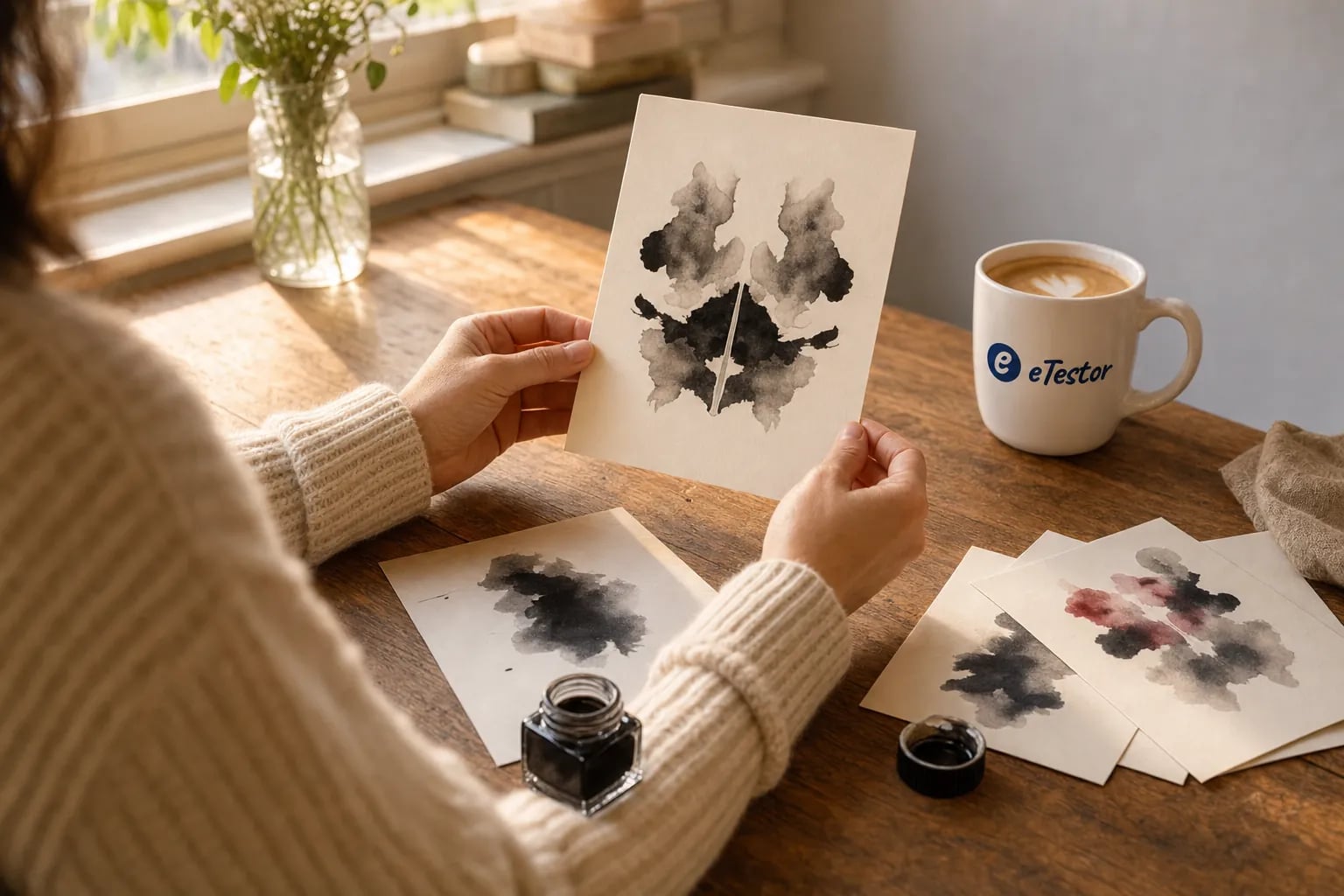
The Rorschach test is a psychological test in which a person looks at ten inkblots, one at a time, and says what each one might be. A psychologist writes down every answer and then codes it: which part of the blot it used, what made it look that way (its shape, movement, color or shading), how well it fits the blot and how common it is. The idea is that the way someone makes sense of an unclear picture shows something about how they think and see.
The blots were made by the Swiss psychiatrist Hermann Rorschach, who published them in his book Psychodiagnostik in 1921. More than a hundred years later the test is still given in clinics and courtrooms, and still argued over. Research finds that some of its scores, mostly the ones about thinking and perception, hold up well, while many others don't. We think that split is the most useful thing to know about the Rorschach, and it runs through this guide.
One note before you read on: the inkblot test on eTestor is not the Rorschach. Our twelve cards were made for us and our scoring is our own. We explain the difference further down.
How the Rorschach test is given and scored
A Rorschach session has two parts. In the first, the psychologist hands over the cards in a fixed order and asks what each one might be. Every word is written down. In the second part, called the inquiry, the cards come back and the psychologist asks, answer by answer, where on the blot you saw it and what made it look like that. The inquiry matters because the scoring depends far more on how you saw something than on what you saw.
Rorschach died the year after his book came out, so the full scoring systems were built by others, starting from the categories he had sketched. Several competing systems grew up in the United States until the psychologist John Exner pulled them together into the Comprehensive System, first published in 1974. For decades it was the standard. In 2011 a group of researchers who had worked with Exner (Gregory Meyer, Donald Viglione, Joni Mihura, Robert Erard and Philip Erdberg) published a successor, the Rorschach Performance Assessment System, or R-PAS. It keeps most of the coding and changes the instructions and the norms.
The best-known change is how many answers you're asked for. In R-PAS people are asked for two, or maybe three, answers per card; if they give only one they're prompted for another, and after four the card is taken back. The aim was fewer very short and very long records, which made scores hard to compare (Viglione and colleagues, Clinical Psychology & Psychotherapy, 2015, doi:10.1002/cpp.1913). A meta-analysis of six studies with 713 people found that this changed the number of answers and very little else (Hosseininasab and colleagues, Journal of Personality Assessment, 2019, doi:10.1080/00223891.2017.1393430). In both systems the coded answers are added up and compared with norms from large reference samples, which is what turns "two people pulling at something" into a score a psychologist can interpret.
Our inkblot test works differently. You see twelve ink cards drawn for eTestor, never the Rorschach plates, and answer 48 questions about them, four per card, in about 10 minutes. Instead of saying whatever comes to mind, you pick an option or rate a statement: where your eye went first, whether the shape was moving, whether you saw people. Your reading style is free when you finish; the full report shows all six scores. How it compares with the real thing is explained below.
What a Rorschach answer is scored on
Location: where on the blot
Whether the answer uses the whole blot, a large and commonly used part of it, a small or unusual detail, or the white space around and inside the ink. Someone who sees "a moth" in the whole card and someone who sees "a face" in a tiny gap at the edge are doing different things, and the mix across all ten cards is what gets read.
Developmental quality: how parts are put together
Whether the answer is a single vague thing ("a cloud") or several parts joined into something with a clear shape and relationship ("two people bending over to lift a basket"). Joining parts in a way that makes sense is scored differently from joining them in a way that doesn't.
Determinants: what made it look that way
The most distinctive part of the scoring. The psychologist codes whether the answer was driven by shape alone, by movement (people, animals or objects doing something), by color, by shading and texture ("it looks furry"), by a sense of depth, or by the two halves of the blot being seen as a pair or a reflection. This is why the inquiry exists: the same answer can rest on very different reasons.
Form quality: how well it fits
Whether the shape you named actually matches the shape of the ink. Most answers fit well enough that another person can see them once they're pointed out. A record in which many answers fit poorly suggests that perception is drifting away from what's really there, and scores built on this had some of the strongest research support of any Rorschach variable.
Content: what it is
What the answer is about: whole people, parts of people, animals, anatomy, nature, objects, art, blood, fire and so on. Content is the part most people think the test is about, and the part the scoring systems lean on least.
Popular answers: what most people see
A short list of answers given so often to particular cards that they're scored as "popular". Giving some of them shows you see what most people see. Giving almost none, or nothing else, is noted too.
Special scores: odd reasoning and wording
Codes for answers that combine things in impossible ways, follow strange logic or use strange language. They are markers of disordered thinking, and together with form quality they feed the scores that research supports best.
Who was Hermann Rorschach?
Hermann Rorschach was born in Zurich in 1884. His father was an art teacher, and as a schoolboy he was nicknamed Klecks, German for inkblot. As a psychiatrist in Switzerland he turned blots into an experiment: he showed blots to his patients and to healthy people and compared what they saw.
He published the results in 1921 in Psychodiagnostik, based on about 300 patients and 100 other people. He died suddenly in April 1922, aged 37, before the test became famous. The detailed scoring systems and the norms used today were built after his death, on top of the basic categories he had sketched.
What do the ten Rorschach cards look like?
Each card is one symmetrical blot printed on white card, numbered I to X and always shown in the same order. Five are black and grey, two add patches of red, and the last three are in several colors. The grey cards are full of uneven shading, and shading is one of the things the scoring looks at.
People often assume the blots were made to look like nothing in particular. They weren't quite. Several have shapes that most people name in the same way, and that is what makes the popular answers possible. A completely shapeless blot would tell the psychologist nothing about whether you see what other people see.
Why the original inkblots aren't shown here
In 2009 an emergency doctor from Saskatchewan, James Heilman, uploaded all ten plates to Wikipedia along with the answers people most often give. The images were out of copyright by then, so nothing illegal had happened. Psychologists objected anyway. "The more test materials are promulgated widely, the more possibility there is to game it," said Bruce Smith, president of the International Society of the Rorschach and Projective Methods. A spokeswoman for the test's publisher called the posting "unbelievably reckless and even cynical". Heilman's answer: "Show me the evidence." (NBC Los Angeles reported the dispute on 29 July 2009, following The New York Times.)
We're keeping them off this page, and the reason is practical. Psychologists still use the cards in clinical and forensic assessments that matter to people's lives, and an answer someone rehearsed from a website makes that assessment less useful for the person taking it. The images are easy to find if you want them. We'd rather this page explain the test than help anyone prepare for it.
Is the Rorschach test still used today?
Yes. Lilienfeld, Wood and Garb opened their 2000 review by noting that projective techniques "continue to be widely used in clinical and forensic settings", and since then the test has gained a new scoring system (R-PAS, 2011) and a large body of new research.
In our reading of the evidence, it's most defensible where a psychologist wants to see how someone handles a task with no clear right answer: whether their perception stays accurate, whether their reasoning drifts, how they organize something confusing. Those are the parts research supports best. It's on much weaker ground for questions about emotions, inner conflicts or personality traits, which is unfortunately what most people imagine it's for.
Inkblot test meaning: what does your answer say about you?
Much less than most websites suggest. There is no dictionary in which a bat means one thing and a butterfly another. A psychologist doesn't read a single answer as a symbol. They look at patterns across the whole record: how often you used the whole blot, how often your answers fit the shape, how often you saw movement or people, how often you saw what most people see. One strange answer means nothing on its own. A record in which most answers fit the ink poorly, or join things in impossible ways, is what gets attention.
That's why lists of "what your inkblot answer means" don't work: they shrink a test scored on dozens of patterns to one meaning per card.
Other projective tests, and how they compare
The Rorschach belongs to a family called projective tests, built on the idea that people reveal themselves when they describe something ambiguous. The other two best known are the Thematic Apperception Test, in which you tell a story about an unclear picture of people, and human figure drawings, in which you draw a person. The same 2000 review covered all three. It found support for a small number of Rorschach and TAT indexes, not for most of them, and even more limited evidence for drawings (doi:10.1111/1529-1006.002).
Questionnaires work the other way round: they ask you directly. They're easier to fake, but the best of them have far stronger evidence behind them. If you want a measure of personality that research backs, the Big Five is the one to know; our Big Five guide explains it, and the Big Five test measures it.
How eTestor's inkblot test differs from the Rorschach
Our inkblot test borrows the Rorschach's questions, not its cards or its claims. Six things are scored, each a loose cousin of an old Rorschach category: taking in the whole blot (location), going to the small details (also location), seeing movement, seeing people (human content), reacting to color and shading, and skipping the obvious reading for one of your own (the popular-answer count, turned around). Your highest score gives your reading style: the Big-Picture Seer, the Detail Hunter, the Storyteller, the People Reader, the Mood Reader or the Inventor.
Three differences matter. Our cards are original, so nothing you answer can be compared with Rorschach norms. You choose from options instead of speaking freely, which makes the test quick and consistent and much less rich. And nobody has studied whether our styles predict anything. Take it the way you'd take a long talk about shapes in the clouds: an interesting look at how you see, not a reading of who you are. If you like that kind of question, the color personality test and the creativity type test are in the same spirit.
It takes about 10 minutes.
What does the Rorschach test measure? What research says
The best-known critique is a 2000 review by Scott Lilienfeld, James Wood and Howard Garb (Psychological Science in the Public Interest, doi:10.1111/1529-1006.002). They concluded that a small number of Rorschach indexes had empirical support but the substantial majority did not, and that with a few exceptions the test added little beyond what other measures already showed. They also found that published studies reported larger effects than unpublished ones, a sign that weaker results had stayed in the drawer.
The most thorough answer came in 2013. Joni Mihura and colleagues reviewed the research on the 65 main variables of the Comprehensive System (Psychological Bulletin, doi:10.1037/a0029406). Checked against criteria from outside the person, such as observer ratings or psychiatric diagnoses, the average validity was r = .27; checked against people's own self-reports it was .08. Thirteen variables had excellent support, 17 good, 10 modest and 13 little or none, and 12 had never been properly studied. The best supported were those about thinking and perception, such as the Perceptual-Thinking Index. The weakest tended to be very rare scores or some of the newer indexes, such as the Egocentricity Index, and the authors said their findings were less positive than those in the test's own manual. The authors read the gap between outside criteria and self-report as a reason to use different methods side by side.
Critics and defenders then agreed on more than you'd expect. In a 2015 comment, Wood, Garb, Lilienfeld and colleagues accepted that four groups of cognitive scores are related to cognitive ability, impairment and thought disorder, and said they were now comfortable endorsing them in some settings (doi:10.1037/a0036005). On the rest they still disagreed: adding unpublished studies lowered several estimates, and they concluded the evidence was insufficient to use the test for emotional characteristics such as negative affect. Mihura's team replied in the same issue (doi:10.1037/a0038445).
Our reading: the Rorschach is a reasonable way to watch someone think through an unclear problem and a weak way to read their feelings or hidden personality. It belongs in the hands of a trained psychologist, next to interviews and other tests. No inkblot quiz, ours included, can do what it does.
Questions people ask
How many cards are in the Rorschach test?
Ten, always shown in the same order. Five are black and grey, two add red, and the last three are in several colors.
Can you fail a Rorschach test?
No. There are no right or wrong answers and no pass mark. The answers are coded and compared with norms, and a psychologist looks at the overall pattern.
What is the most common answer on the Rorschach?
Each card has a few answers given often enough to be scored as popular. We don't list them, for the reason explained above: the cards are still used in real assessments.
Is the Rorschach test accurate?
Partly. Its scores about perception and thinking have good research support. Many of its other scores, especially those about emotions, have weak or no support.
Can the Rorschach diagnose a mental illness?
Not on its own. Some of its scores are related to disordered thinking, but any diagnosis comes from a clinician weighing interviews, history and several tests together.
Can I take the real Rorschach test online?
No. The real test needs an examiner, the inquiry and trained coding against norms. Online versions that show the original plates can't score them that way. Our inkblot test uses its own cards and says openly that it's for fun.
Sources
- Lilienfeld, S. O., Wood, J. M., & Garb, H. N. (2000). The scientific status of projective techniques. Psychological Science in the Public Interest, 1(2), 27-66. doi.org/10.1111/1529-1006.002
- Mihura, J. L., Meyer, G. J., Dumitrascu, N., & Bombel, G. (2013). The validity of individual Rorschach variables: Systematic reviews and meta-analyses of the Comprehensive System. Psychological Bulletin, 139(3), 548-605. doi.org/10.1037/a0029406
- Wood, J. M., Garb, H. N., Nezworski, M. T., Lilienfeld, S. O., & Duke, M. C. (2015). A second look at the validity of widely used Rorschach indices: Comment on Mihura, Meyer, Dumitrascu, and Bombel (2013). Psychological Bulletin, 141(1), 236-249. doi.org/10.1037/a0036005
- Mihura, J. L., Meyer, G. J., Bombel, G., & Dumitrascu, N. (2015). Standards, accuracy, and questions of bias in Rorschach meta-analyses: Reply to Wood, Garb, Nezworski, Lilienfeld, and Duke (2015). Psychological Bulletin, 141(1), 250-260. doi.org/10.1037/a0038445
- Viglione, D. J., Meyer, G. J., Jordan, R. J., Converse, G. L., Evans, J., MacDermott, D., & Moore, R. (2015). Developing an alternative Rorschach administration method to optimize the number of responses and enhance clinical inferences. Clinical Psychology & Psychotherapy, 22(6), 546-558. doi.org/10.1002/cpp.1913
- Hosseininasab, A., Meyer, G. J., Viglione, D. J., Mihura, J. L., Berant, E., Resende, A. C., Reese, J., & Mohammadi, M. R. (2019). The effect of CS administration or an R-Optimized alternative on R-PAS variables: A meta-analysis of findings from six studies. Journal of Personality Assessment, 101(2), 199-212. doi.org/10.1080/00223891.2017.1393430
- Morales, M. (2009, July 29). Answers to the inkblot test revealed on Wikipedia. NBC Los Angeles. www.nbclosangeles.com/news/national-international/natl-the-inkblot-test-makes-its-way-to-wikipedia/1858129/
Written by the eTestor team. We write every guide ourselves and check each study we cite against its original record. Last updated . How we build and score our tests · About eTestor