
Photographic Memory: Is It Real, and Do You Have One?
What eidetic memory really is, how rare it is, how people with extraordinary memories do it, and what actually improves yours
· 11 min read
Take the Memory Test: free, and your main result is free when you finish.
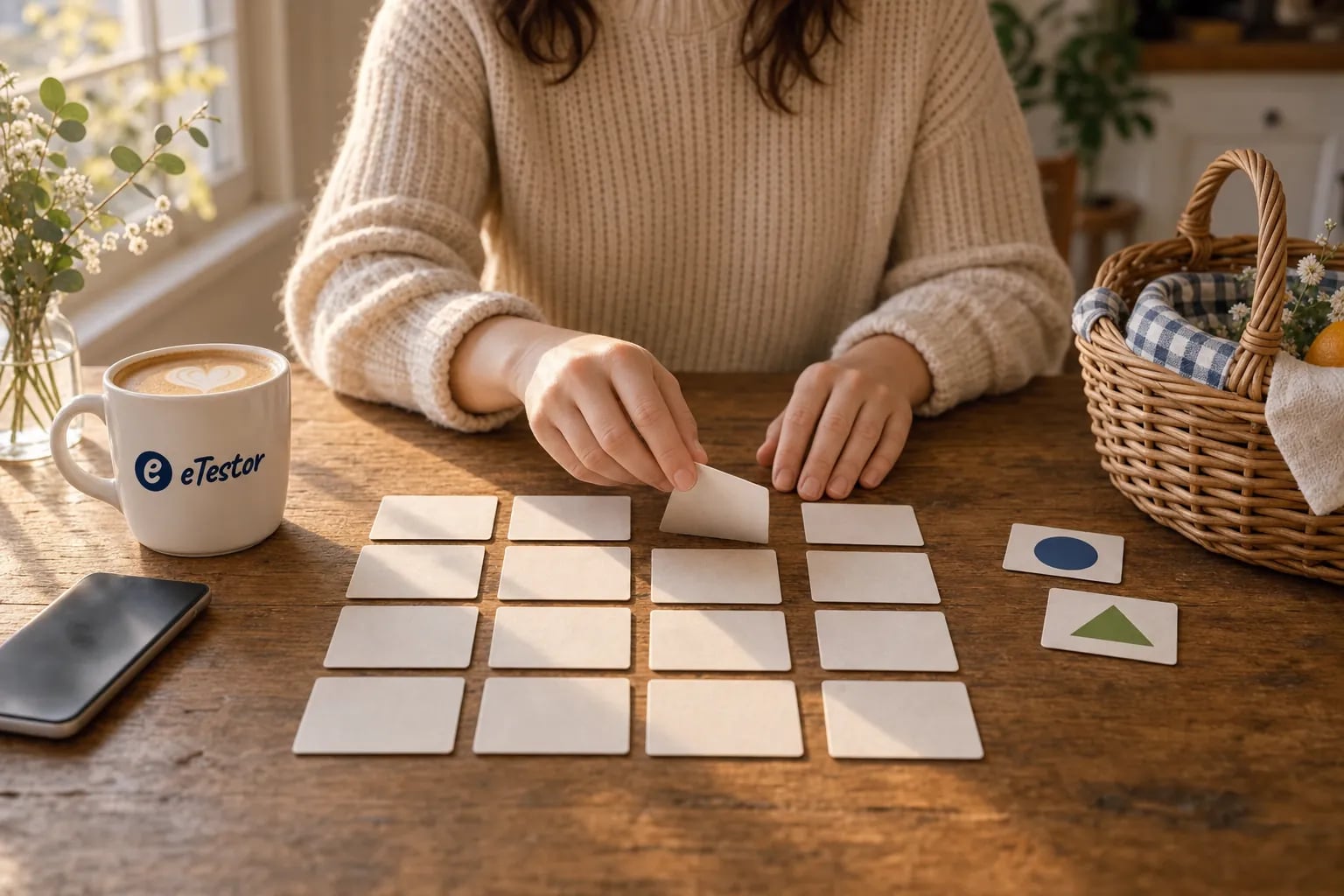
Is photographic memory real?
In the sense most people mean it, a memory that takes a perfect snapshot of a page and lets you read it back later, there's no good evidence that photographic memory exists in adults. What does exist is rarer and odder: a vivid, picture-like memory called eidetic imagery, found in a small share of children; a small number of people, studied since 2006, who remember nearly every day of their lives; and memory champions who memorize hundreds of items with techniques anyone can learn.
"Eidetic memory" is the term people search for most, usually as another name for the same thing. Researchers use eidetic imagery for something narrower: still seeing a picture, as if it were in front of you, for a while after it has gone. Ralph Haber, who studied it in schoolchildren for ten years, concluded that eidetic images are available to only "a small percentage" of children aged 6 to 12 and are "virtually nonexistent in adults" (Behavioral and Brain Sciences, 1979, doi:10.1017/S0140525X00064542).
So if people tell you that you have a photographic memory, the likely truth is good news of a different kind: you have a strong memory for a certain kind of material, and habits that make it stick. This guide is about telling the two apart.
How to tell if you have a photographic memory
Here is the honest test. A photographic memory would let you look at a page for half a minute, look away, and then read off the fourth word of line 14, or read the whole page backwards as easily as forwards. Haber's criteria for a real eidetic image work along the same lines. People describe the image as if it were projected on a surface in front of them, they talk about it in the present tense, and they can move their eyes across it while it stays where it is. Someone remembering in the ordinary way talks in the past tense and rebuilds the page from what they know.
Almost everyone who tries this finds they can't. What they usually have is something else: a good memory for where things were (top left, under the diagram), fast reading of a subject they already know well, or a knack for grouping material into meaningful chunks. Those are real skills, and they can be measured.
That's what our memory test does. Each of its 50 questions first shows you something to remember on a screen of its own, with a countdown: a list of words, a string of digits, names paired with details, a grid with some squares filled, or a short notice with times and prices. Then it disappears and you answer one multiple-choice question about it. There are five areas of ten questions, each area gets harder as it goes, and you can't go back. It takes about 15 minutes. Your total out of 50 is free when you finish; the full report breaks it down by area and explains it. A perfect score in an area means a strong short-term memory for that kind of material. It doesn't mean a photographic one.
Kinds of exceptional memory, and what each one really is
Eidetic imagery
The closest real thing to a photographic memory. After looking at a picture for a short time, a child with eidetic imagery describes still seeing it on the blank surface where it was, in the present tense, and can look around inside it. Haber found it in a small percentage of children aged 6 to 12 and almost never in adults, and research has failed to link it to intelligence or to any other cognitive, neurological or emotional measure.
Highly superior autobiographical memory (hyperthymesia)
Give these people a date and they can tell you what day of the week it was and what they did. Their memory for their own lives and for public events is far above normal, yet on standard laboratory memory tests most score like everyone else. It's a memory for days, not for pages.
Trained memory
What memory champions have. They aren't born with unusual brains; they use techniques, above all the method of loci, in which each item is pictured at a spot along a familiar route. With practice the results look superhuman, such as recalling 70 of 72 words seen once, twenty minutes later, and they can be learned.
Skilled memory
Memory built by long practice on one kind of material. In a classic study, a volunteer known as SF practiced remembering strings of digits for more than 230 hours and raised his span from 7 digits to 79 (Ericsson, Chase and Faloon, Science, 1980, doi:10.1126/science.7375930). The authors' conclusion: with an appropriate mnemonic system, "there is seemingly no limit to memory performance with practice."
Ordinary short-term memory
What everyone has, and what most memory tests measure: holding a few things in mind for seconds, like a code you're about to type. Its limit is small, roughly four chunks at once, and the size of a chunk is where people differ most.
Eidetic vs photographic memory: what's the difference?
In everyday speech the two mean the same thing. In research they don't. A photographic memory, as people imagine it, would be permanent and exact: a stored copy you could consult years later. Eidetic imagery is neither. It's a picture that lingers for a while after you look away, and then fades.
Haber's tests were built to separate an eidetic image from two other things. An afterimage, like the spot you see after looking at a lamp, moves when your eyes move and lasts only a moment; an eidetic image stays in place while you look around it, and lasts longer. Ordinary memory feels like knowing, not seeing, and people describe it in the past tense ("there was a cat on the left"), where a child with an eidetic image says "the cat is on the left".
How many people have a photographic memory?
Among adults, as far as research can tell, essentially no one. Among children aged 6 to 12, a small percentage show eidetic imagery, and in Haber's long-term study it stayed remarkably stable through the elementary school years. He also found no higher rate among preschool children, or among people who couldn't read in studies across cultures, which argues against the idea that it's an immature kind of memory that children grow out of as they learn to read.
The best-known claim of an adult with it is a 1970 Nature paper by Charles Stromeyer and Joseph Psotka (doi:10.1038/225346a0). They described a woman who looked at a pattern of random dots with one eye, then later at a second pattern with the other eye, and saw the hidden figure that appears only when the two are combined. The case was never repeated with anyone else in the published research we could find. When John Merritt printed similar tests in newspapers and magazines and invited readers to try, his 1979 report was titled "None in a million".
Hyperthymesia (HSAM): the people who remember every day
In 2006 researchers at the University of California, Irvine described a woman, called AJ in the paper, who could accurately recall vast amounts about her own life, across most of her lifetime, without using memory techniques (Parker, Cahill and McGaugh, Neurocase, doi:10.1080/13554790500473680). By 2012 the same group had studied eleven people with the ability and named it highly superior autobiographical memory, or HSAM (LePort and colleagues, Neurobiology of Learning and Memory, doi:10.1016/j.nlm.2012.05.002).
Two findings make it unlike the photographic memory of films. First, on most standard laboratory memory tests the HSAM group scored like age- and sex-matched controls. Their gift is for days and events, not for lists or pages. Second, their memories are not recordings. In a 2013 study they were at least as prone to false memories as anyone: like controls, they "recognized" words that had never been on a list, and they absorbed misleading details about a slideshow of photos more than controls did (Patihis and colleagues, PNAS, doi:10.1073/pnas.1314373110). The authors suggest that even these remarkable memories are put together by the same fallible, reconstructive process as everyone else's.
We find that reassuring. If the best autobiographical memories ever measured still rebuild rather than replay, nobody should feel bad about a memory that does the same.
How memory champions do it: the method of loci
In 2003 Eleanor Maguire and colleagues scanned the brains of people who competed in events like the World Memory Championships and gave them a battery of tests (Nature Neuroscience, doi:10.1038/nn988). Their superior memory was not explained by exceptional intelligence or by differences in brain structure. They used a spatial learning strategy, and while memorizing they engaged brain regions such as the hippocampus that matter for spatial memory.
That strategy is usually the method of loci, also called the memory palace. A 2017 study shows how far it goes. Seventeen memory athletes recalled on average 70.8 of 72 words twenty minutes after seeing them; matched controls recalled 39.9 (Dresler and colleagues, Neuron, doi:10.1016/j.neuron.2017.02.003). Then 51 men with no experience of memory techniques were divided into groups, and one group trained in the method for 30 minutes a day over 40 days. In training their score on a five-minute word task rose from about 17 words to about 42. Their brain networks shifted toward the pattern seen in the champions, and the more they shifted, the larger the memory gains, up to four months after training.
To try it, pick a route you know well, such as the walk from your front door to your kitchen, and fix ten spots along it in order. To remember a list, place each item at one spot as a vivid, slightly absurd picture: milk pouring out of the letterbox, eggs balanced on the coat hook. To recall, walk the route in your head. It's built for lists and sequences; for understanding a textbook chapter, the habits in the last section of this guide matter more.
How much can short-term memory hold?
In 1956 George Miller wrote his famous paper on "the magical number seven, plus or minus two" (Psychological Review, doi:10.1037/h0043158). Later work found the real limit is smaller. Nelson Cowan, reviewing a wide range of studies, put it at about four chunks and noted that Miller's seven "was meant more as a rough estimate and a rhetorical device than as a real capacity limit" (Behavioral and Brain Sciences, 2001, doi:10.1017/S0140525X01003922).
The key word is chunk. A chunk is whatever you can hold as one unit. For a child learning to read, a letter is a chunk; for you, a whole word is. A ten-digit phone number is easier as three groups than as ten separate digits, and SF's 79 digits came from a system for grouping them that he built up with practice. Most of what looks like a bigger memory is better chunking, which is good news, because chunking can be practiced.
That's also why our memory test gets harder in each area by adding more to hold: the point where items stop sticking tells you more about your memory than the total does.
How to improve your memory: what research actually supports
The two habits with the strongest evidence are simple and slightly uncomfortable. The first is testing yourself instead of rereading. In a 2006 experiment, students who studied a passage and then practiced recalling it remembered less five minutes later than students who simply reread it, but remembered substantially more two days and one week later; rereading made them more confident, not better (Roediger and Karpicke, Psychological Science, doi:10.1111/j.1467-9280.2006.01693.x).
The second is spacing your practice out. A review of 317 experiments found that study sessions spread out beat the same time crammed together, and that the longer you need to remember something, the longer the best gap between sessions (Cepeda and colleagues, Psychological Bulletin, 2006, doi:10.1037/0033-2909.132.3.354). A large review of ten study techniques rated these two, practice testing and distributed practice, as the only ones of high utility. Highlighting and rereading, two techniques students report relying on heavily, were rated low (Dunlosky and colleagues, Psychological Science in the Public Interest, 2013, doi:10.1177/1529100612453266).
Brain-training games are the third thing people ask about. A review of the studies their makers cite found good evidence that they improve the games themselves, less that they help with similar tasks, and little that they improve everyday memory or thinking (Simons and colleagues, Psychological Science in the Public Interest, 2016, doi:10.1177/1529100616661983). If you have a quarter of an hour, quizzing yourself on something you actually need to remember is the better bet. And since spacing only works if you start early, our procrastination test may be more useful to your memory than it sounds.
It takes about 15 minutes.
What a memory test can and can't tell you
A memory test like ours measures how much you can hold in mind for a few seconds and pick out from close wrong answers, on one day, under one set of conditions. It's a fair snapshot of short-term memory for words, digits, names, positions and details. A tired evening, a buzzing phone and whether you used a strategy can all move the score, so one sitting is an estimate, not a fixed trait.
It can't measure long-term memory, which is what most people mean when they worry about forgetting, and it can't tell you anything about dementia, memory loss or any medical condition. If you're worried about changes in your memory, that's a conversation for a doctor, not a quiz.
It also can't tell you whether you have a photographic memory, because no short multiple-choice test could. What it can show is where your memory is strongest and where it starts to slip, and that's the part you can do something about. If you want the wider picture of how you reason, our IQ test covers that, and our guide to IQ scores explains what the numbers mean.
Questions people ask
Is photographic memory real?
Not in the sense of a perfect, permanent snapshot. Eidetic imagery, a picture that lingers for a while after looking, is real but found in a small share of children and almost never in adults.
What percentage of people have a photographic memory?
Among adults, essentially none that research has confirmed. Among children aged 6 to 12, a small percentage show eidetic imagery.
Is hyperthymesia the same as photographic memory?
No. People with hyperthymesia (HSAM) remember the days of their own lives in remarkable detail, but most score normally on ordinary memory tests and can still form false memories.
Can you train yourself to have a photographic memory?
No, but you can train a memory that does some of the same tricks. Novices who practiced the method of loci for 30 minutes a day over six weeks more than doubled the words they could memorize in five minutes.
Is photographic memory genetic?
Nobody has shown that it is, partly because nobody has reliably shown adults who have it. Eidetic imagery in children hasn't been linked to intelligence or any other measured ability.
How many things can you hold in short-term memory?
About four chunks at once, according to Cowan's review. Grouping items into bigger chunks, like a phone number in three parts, is how people hold more.
Is a perfect score on a memory test a sign of a photographic memory?
No. It's a sign of a strong short-term memory for that material, and often of a good strategy such as grouping or linking items into a story.
Sources
- Haber, R. N. (1979). Twenty years of haunting eidetic imagery: Where's the ghost? Behavioral and Brain Sciences, 2(4), 583-594. doi.org/10.1017/S0140525X00064542
- Stromeyer, C. F., & Psotka, J. (1970). The detailed texture of eidetic images. Nature, 225(5230), 346-349. doi.org/10.1038/225346a0
- Merritt, J. O. (1979). None in a million: Results of mass screening for eidetic ability using objective tests published in newspapers and magazines. Behavioral and Brain Sciences, 2(4), 612. doi.org/10.1017/S0140525X00064748
- Parker, E. S., Cahill, L., & McGaugh, J. L. (2006). A case of unusual autobiographical remembering. Neurocase, 12(1), 35-49. doi.org/10.1080/13554790500473680
- LePort, A. K. R., Mattfeld, A. T., Dickinson-Anson, H., Fallon, J. H., Stark, C. E. L., Kruggel, F., Cahill, L., & McGaugh, J. L. (2012). Behavioral and neuroanatomical investigation of Highly Superior Autobiographical Memory (HSAM). Neurobiology of Learning and Memory, 98(1), 78-92. doi.org/10.1016/j.nlm.2012.05.002
- Patihis, L., Frenda, S. J., LePort, A. K. R., Petersen, N., Nichols, R. M., Stark, C. E. L., McGaugh, J. L., & Loftus, E. F. (2013). False memories in highly superior autobiographical memory individuals. Proceedings of the National Academy of Sciences, 110(52), 20947-20952. doi.org/10.1073/pnas.1314373110
- Maguire, E. A., Valentine, E. R., Wilding, J. M., & Kapur, N. (2003). Routes to remembering: The brains behind superior memory. Nature Neuroscience, 6(1), 90-95. doi.org/10.1038/nn988
- Dresler, M., Shirer, W. R., Konrad, B. N., Müller, N. C. J., Wagner, I. C., Fernández, G., Czisch, M., & Greicius, M. D. (2017). Mnemonic training reshapes brain networks to support superior memory. Neuron, 93(5), 1227-1235. doi.org/10.1016/j.neuron.2017.02.003
- Ericsson, K. A., Chase, W. G., & Faloon, S. (1980). Acquisition of a memory skill. Science, 208(4448), 1181-1182. doi.org/10.1126/science.7375930
- Miller, G. A. (1956). The magical number seven, plus or minus two: Some limits on our capacity for processing information. Psychological Review, 63(2), 81-97. doi.org/10.1037/h0043158
- Cowan, N. (2001). The magical number 4 in short-term memory: A reconsideration of mental storage capacity. Behavioral and Brain Sciences, 24(1), 87-114. doi.org/10.1017/S0140525X01003922
- Roediger, H. L., & Karpicke, J. D. (2006). Test-enhanced learning: Taking memory tests improves long-term retention. Psychological Science, 17(3), 249-255. doi.org/10.1111/j.1467-9280.2006.01693.x
- Cepeda, N. J., Pashler, H., Vul, E., Wixted, J. T., & Rohrer, D. (2006). Distributed practice in verbal recall tasks: A review and quantitative synthesis. Psychological Bulletin, 132(3), 354-380. doi.org/10.1037/0033-2909.132.3.354
- Dunlosky, J., Rawson, K. A., Marsh, E. J., Nathan, M. J., & Willingham, D. T. (2013). Improving students' learning with effective learning techniques: Promising directions from cognitive and educational psychology. Psychological Science in the Public Interest, 14(1), 4-58. doi.org/10.1177/1529100612453266
- Simons, D. J., Boot, W. R., Charness, N., Gathercole, S. E., Chabris, C. F., Hambrick, D. Z., & Stine-Morrow, E. A. L. (2016). Do "brain-training" programs work? Psychological Science in the Public Interest, 17(3), 103-186. doi.org/10.1177/1529100616661983
Written by the eTestor team. We write every guide ourselves and check each study we cite against its original record. Last updated . How we build and score our tests · About eTestor