
Spatial Reasoning Test
Turn, flip, fold and build shapes in your head
Free · No account
What is spatial reasoning?
Spatial reasoning, or spatial ability, is picturing shapes in your head and working out what happens when they turn, flip or fold. You use it to read a map, pack a car, follow flat-pack instructions or read a technical drawing. A spatial reasoning test asks you to turn a shape in your mind, picture its mirror image, unfold a punched sheet of paper or fold a flat pattern into a cube. This one has 48 such puzzles, and your total score is in the full report.
About this test
Four areas, twelve drawn puzzles each: Mental rotation (which shape is the same one turned, not flipped), Mirror images (the shape reflected in a dashed line, across or down), Paper folding (a square sheet folded once or twice and punched: what it looks like unfolded) and Cube nets (which flat pattern of six squares folds into a closed cube). The areas take turns, easiest round first. There are no words or numbers to work with, only shapes.
What you'll discover
Mental rotation
Turning a shape in your head, and telling a turned shape from a flipped one.
Mirror images
Picturing a shape reflected in a line, across or down.
Paper folding
Following one or two folds and a punched hole through to the unfolded sheet.
Cube nets
Seeing which flat pattern of six squares folds into a closed cube.
Understanding the Spatial Reasoning Test
This spatial reasoning test has 48 drawn puzzles in four areas of twelve: mental rotation, mirror images, paper folding and cube nets. The areas take turns, one puzzle from each, and the puzzles get harder as you go. Your total score is in the full report, which also scores each area, so you can see which kinds of puzzle cost you points.
Mental rotation is the most studied spatial task. Roger Shepard and Jacqueline Metzler showed people pairs of drawings of 3D block shapes and asked whether they were the same shape. The time people needed rose in a straight line with the angle between the two, as if they were turning one picture in their mind at a steady speed (Science, 1971, doi:10.1126/science.171.3972.701). Steven Vandenberg and Allan Kuse turned those figures into a paper test in 1978. It gave consistent results, and its scores were linked with other spatial tests and hardly at all with verbal ones (Perceptual and Motor Skills, doi:10.2466/pms.1978.47.2.599), a sign that spatial ability is a separate skill from verbal ability. Our rotation puzzles use flat shapes made of squares, and the hard part is telling a turned shape from a flipped one.
It matters beyond puzzles. Jonathan Wai, David Lubinski and Camilla Benbow followed about 400,000 US high school students for 11 years and found that spatial ability in the teenage years stood out among those who went on to advanced degrees and jobs in science, technology, engineering and math (Journal of Educational Psychology, 2009, doi:10.1037/a0016127). And it can be trained: a meta-analysis of 217 studies found an average training effect of 0.47 standard deviations, which lasted and carried over to spatial tasks that weren't trained (Uttal and colleagues, Psychological Bulletin, 2013, doi:10.1037/a0028446). This is our own test. A program drew every puzzle and computed every answer, so no key depends on anyone's judgment. It has no norms yet, so your score is not a percentile.
Where the Spatial Reasoning Test comes from
Roger Shepard and Jacqueline Metzler showed in 1971 that the time people need to recognize two drawings as the same 3D shape rises in a straight line with the angle between them, as if turning one picture in the mind. Steven Vandenberg and Allan Kuse built a paper-and-pencil group test from their figures in 1978. Paper folding and cube-net questions are long-standing parts of spatial visualization tests. This test is our own construction in that tradition, using flat shapes made of squares; it is not a published instrument.
How the Spatial Reasoning Test is scored
Four areas of twelve drawn puzzles (mental rotation, mirror images, paper folding and cube nets), each scored as the number correct (0 to 12), plus a total out of 48. With four options per puzzle, guessing alone averages 12 of 48. A program drew every puzzle and computed every answer: turned versus flipped by comparing the shapes' squares, unfolded holes by reflecting each hole across each crease, and cube nets by rolling a cube across the pattern (11 of the 35 patterns of six joined squares fold into a cube). The test has no norms yet, so scores are not percentiles, and it gives no IQ.
Based on a published, peer-reviewed model
Questions people ask
Is the spatial reasoning test free?
Taking the test is free, with no account needed: just your email at the end. Your total score is part of the paid report. Every score, the written analysis and the certificate are in the full report: $1.99 (EU: $2.41 incl. VAT) in the first 30 minutes after you finish, $3.99 (EU: $4.83 incl. VAT) after that, or included in eTestor Unlimited.
Is there a spatial IQ test?
Not as a separate IQ. Spatial puzzles are one part of most intelligence tests, alongside verbal and number reasoning, and an IQ comes from comparing all of it with people your age. This test gives a score out of 48 and a score for each area, not an IQ. Our IQ test has a spatial section if you want an IQ estimate.
Is a spatial awareness test the same thing?
Close, not quite. Spatial awareness usually means sensing where you and things around you are in space, as when you park, catch a ball or walk through a crowd. Spatial reasoning is working with shapes in your head. They overlap, and a test on a screen can only measure the second.
What is a good score on a spatial reasoning test?
Each puzzle has four options, so guessing alone averages 12 of 48. Above 24 means you got most of the easier puzzles in every area; 40 or more means you got most of the hard ones too. We don't have norms yet, so read these as rough guides, not percentiles.
Can you improve spatial reasoning?
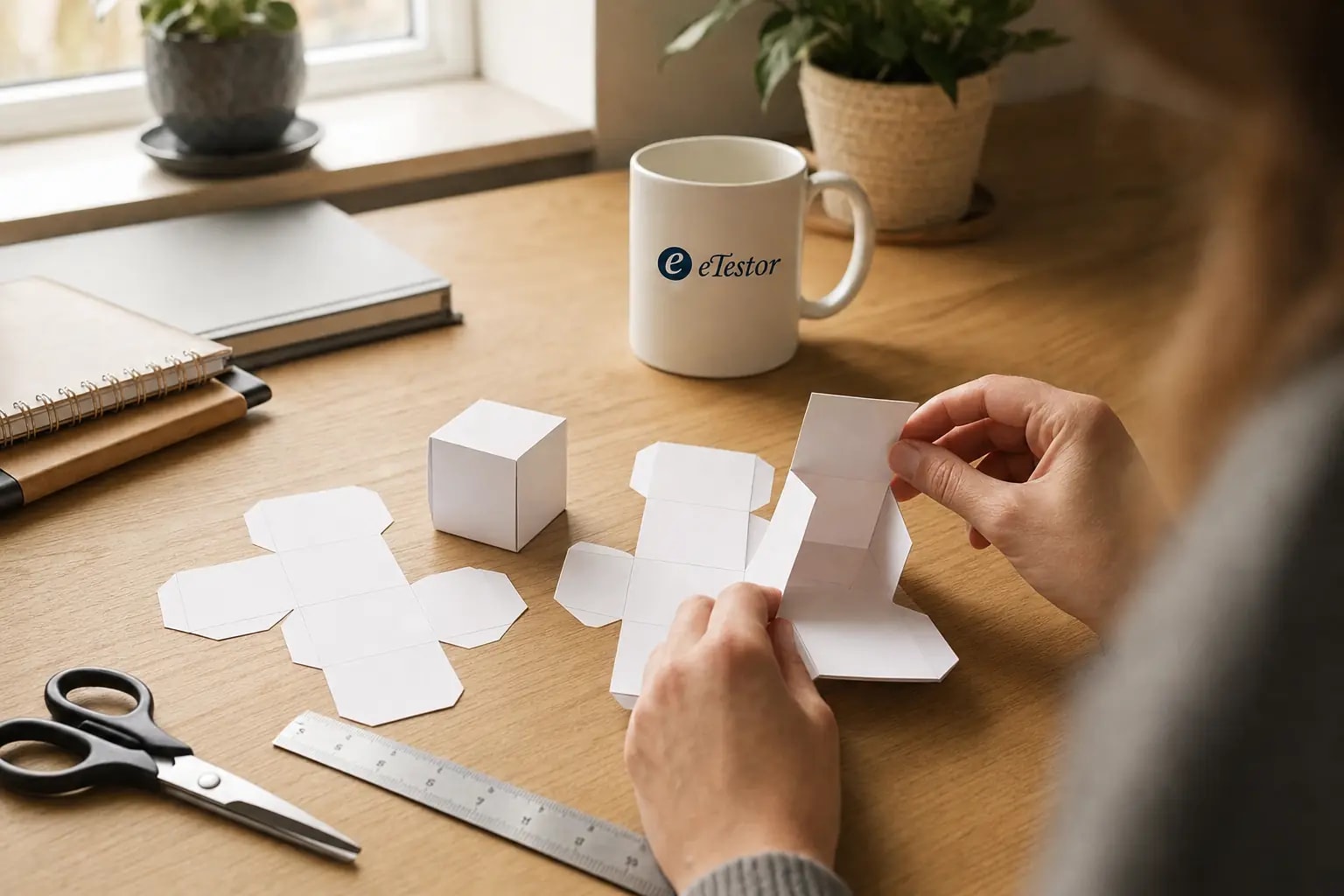
Yes. Across 217 training studies, practice raised spatial skills by about half a standard deviation on average, the gains lasted, and they carried over to spatial tasks that weren't practised (Uttal and colleagues, 2013). Puzzles, building things and drawing all give that kind of practice. For cube nets, cut out and fold a few paper ones.
More Cognitive & Intelligence tests

Reading Comprehension Test
12 passages, 48 questions: main idea, details, words in context and inference.

Critical Thinking Test
48 questions on everyday arguments: assumptions, conclusions, strengthen or weaken, reasoning flaws.
Attention Span Test
40 timed focus tasks: count letters, spot the odd code, compare lines, count symbols.
IQ Test
Pattern matrices, sequences, spatial rotation, logic and a timed speed round — scored to a real IQ with percentile.
Left Brain / Right Brain Test
List-maker or leaper? 44 questions score your analytical and creative sides — honestly, metaphor and all.

Decision-Making Style Test
Analyst, gut reader, counsel gatherer, deliberator, or leaper? 45 scenarios reveal how you really decide.