
Aptitude Test
48 questions across four kinds of reasoning
Free · No account
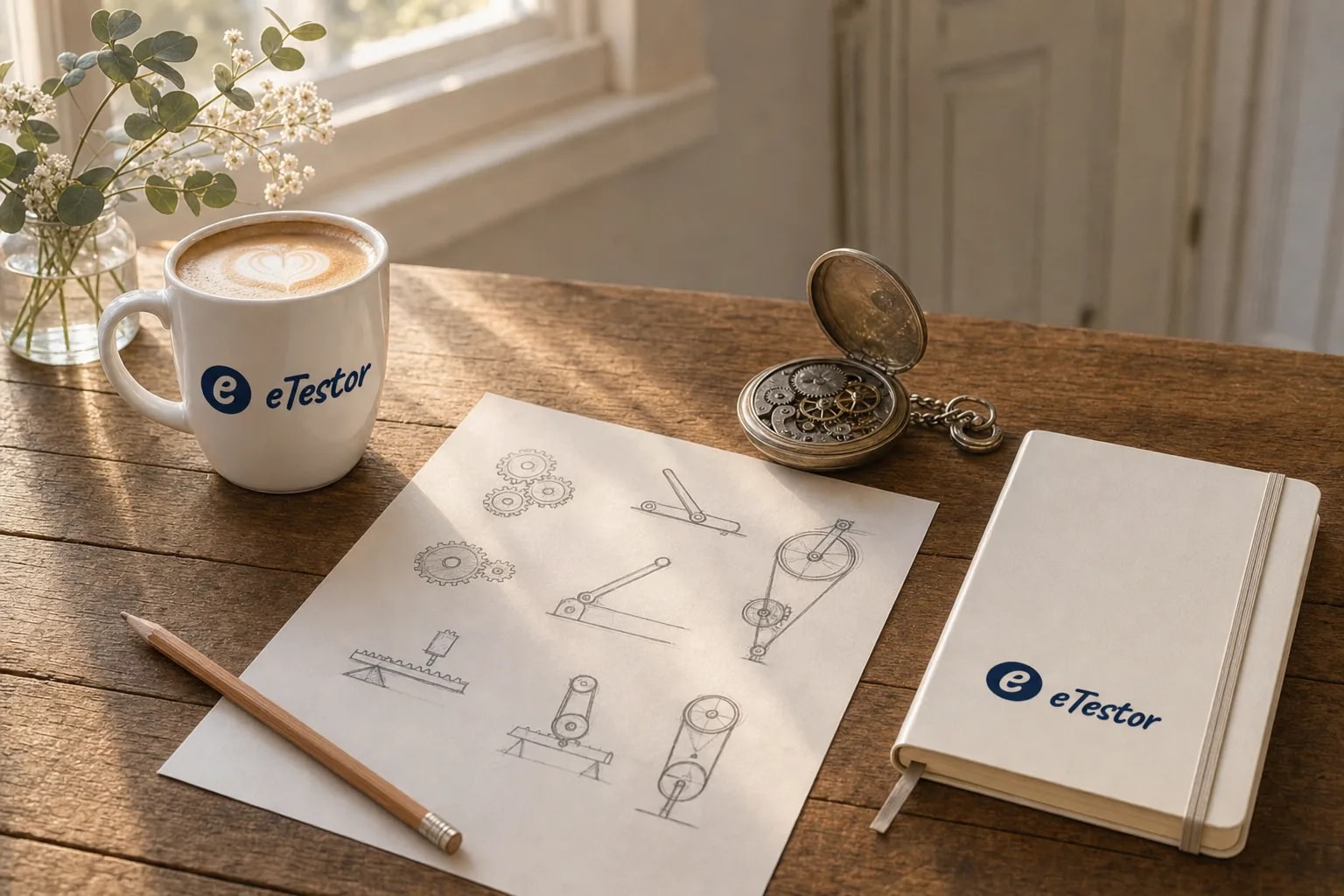
What is an aptitude test?
A general aptitude test asks you to solve problems with numbers, words, patterns and everyday mechanisms. It's a type of cognitive ability test, like those employers use in a psychometric assessment. Here you'll do things like read a small table, decide what a passage actually says or work out which way a gear turns. There are 48 questions, and they get harder as you go. There's no time limit.
About this test
We wrote 12 questions for each of four areas: numerical, verbal, abstract and mechanical reasoning. Abstract series and codes are all presented in text. Every question has four options, and we checked every answer key by recomputing the answer and having someone solve the question independently without seeing the key.
What you'll discover
Numerical reasoning
Work with arithmetic, percentages, ratios and numbers in small tables.
Verbal reasoning
Complete analogies, pick the odd word out and decide what follows from a short passage.
Abstract reasoning
Find the rule behind letter, number and symbol series or codes, all presented in text.
Mechanical reasoning
Work out what happens with gears, levers, pulleys and filling containers, and solve clock and calendar problems.
Understanding the Aptitude Test
Some aptitude test questions ask you to find a rule; others give you the rule and ask what follows. Here, numerical questions cover arithmetic, percentages, ratios and small tables. Verbal questions ask you to complete an analogy, pick the odd word out or draw a conclusion from a passage. Abstract questions use letters, numbers and symbols, all in text. The mechanical section includes gears, levers, pulleys and filling containers, along with clocks and calendars.
Try two examples that aren't on the test. A price drops from $80 to $60. What's the percentage decrease? It's 25%: the $20 drop is a quarter of the original $80. Now picture three gears in a row, each touching the next. If the first turns clockwise, the third does too. The middle gear reverses the direction once, and the third reverses it again. A sketch helps if you lose track of which way each gear turns.
Employers may use a cognitive ability test as one part of a selection process. Schmidt and Hunter (1998, doi:10.1037/0033-2909.124.2.262) found that some of the strongest combinations paired general mental ability with a work sample, an integrity test or a structured interview. Sackett and colleagues (2022, doi:10.1037/apl0000994) found that earlier estimates were too high and ranked structured interviews first. That research is about selection methods, not this test. The paid full report shows how many questions you got right in each area and overall. We don't have norms yet, so it can't tell you how you rank against other people.
Where the Aptitude Test comes from
We wrote this general aptitude test in the tradition of cognitive ability tests used in employee selection. Schmidt and Hunter (1998, doi:10.1037/0033-2909.124.2.262) summarized 85 years of meta-analytic research on 19 methods for predicting job and training performance. The highest validity estimates, about .63 to .65, came from combining general mental ability with a work sample, an integrity test or a structured interview. Sackett and colleagues (2022, doi:10.1037/apl0000994) found that earlier estimates were overcorrected: most methods kept their relative rank, but validity estimates fell by .10 to .20, and structured interviews ranked first. Those findings concern selection methods generally and don't validate this eTestor test.
How the Aptitude Test is scored
The paid full report gives the number correct in each area (0 to 12) and the total out of 48. Each question has four options, so guessing alone averages 12 out of 48. We checked every key by recomputation and by an independent solve without access to the key. The test has no norms yet, so these scores are not percentiles.
Questions people ask
Is this a free aptitude test?
It's free to take all 48 questions. Your total score, scores for the four areas and analysis are available only in the paid full report. Every score, the written analysis and the certificate are in the full report: $1.99 (EU: $2.41 incl. VAT) in the first 30 minutes after you finish, $3.99 (EU: $4.83 incl. VAT) after that, or included in eTestor Unlimited.
Is an aptitude test the same as a psychometric test?
An aptitude test is one kind of psychometric test. If an employer asks you to take a psychometric assessment test, they might mean a test of cognitive abilities like this one, or they might mean a questionnaire about personality. This test asks you to solve problems with right and wrong answers.
What do the scores in the full report mean?
Each area is scored from 0 to 12, and the total is out of 48. With four options per question, guessing alone averages 12 out of 48. That's an average for guessing, not a passing score. We don't have norms yet, so the report doesn't give percentiles.
Can I try a sample aptitude test question?
Here's an abstract reasoning example that isn't on the test: what comes next in A, C, F, J, O? The answer is U. Count the steps from one letter to the next: 2, 3, 4, then 5. Move 6 places on from O and you land on U.
How is this different from the career aptitude test?
This test scores how many reasoning questions you answer correctly. Our [career aptitude test] uses Holland codes to match your interests to careers. Liking a kind of work and solving a problem about it are different things.
How should I approach the harder aptitude test questions?
For percentages, write down what counts as the whole before you divide. For passage questions, check that the answer follows from the words on the page, even if another answer sounds plausible. For gears or levers, draw what moves and mark the direction with arrows. There's no time limit, so you can check your reasoning before answering.
More Cognitive & Intelligence tests
Numerical Reasoning Test
48 questions on percentages, ratios, data tables, number series and word problems.
IQ Test
Pattern matrices, sequences, spatial rotation, logic and a timed speed round — scored to a real IQ with percentile.

Left Brain / Right Brain Test
List-maker or leaper? 44 questions score your analytical and creative sides — honestly, metaphor and all.

Decision-Making Style Test
Analyst, gut reader, counsel gatherer, deliberator, or leaper? 45 scenarios reveal how you really decide.

Curiosity Test
Wanderer or digger? 40 statements measure the two appetites of a curious mind.

Memory Test
50 questions: study a list, a number, names, a grid or a notice, then answer from memory.